A reverse phone lookup can identify an unfamiliar caller, reveal possible spam activity, or help a business verify customer records. However, Spy Dialer and Service Objects serve different users. Reverse phone lookup SpyDialer is a free browser-based tool for occasional personal searches, while Service Objects provides commercial APIs for automated phone validation and business data management.
What Each Service Does
Spy Dialer lets users search US phone numbers through a public website. Available results may include the caller’s name, general location, carrier, line type, and spam reports. It also provides separate people, address, and email search options.
No installation or account is required. Users enter a ten-digit number and review the available information in their browser. This simplicity makes it useful for checking a missed call or unexpected text.
Service Objects is designed for businesses and developers. Its closest equivalent is DOTS GeoPhone Plus, a reverse lookup API covering US and Canadian numbers. Companies can connect it to websites, applications, customer relationship management systems, and lead databases.
Reverse Phone Lookup SpyDialer Features
Spy Dialer focuses on quick, accessible caller identification. Depending on data availability, a search may return:
- An associated person or business name
- Mobile, landline, or VoIP classification
- The carrier or service provider
- A general city and state
- Community reports about spam or scams
The website currently says users can complete up to 50 free searches per day without entering payment information. This differs from some older third-party discussions claiming that only a few searches were free. Current limits should always be confirmed on the official website.
Spy Dialer supports US-based numbers only. It also warns that its public-source data can be incomplete, outdated, or incorrect. A displayed name is therefore a clue rather than proof of who currently uses the number.
Service Objects Features
Service Objects offers several phone-data products, but GeoPhone Plus is the most relevant for reverse lookup. Its official product page lists information such as:
- Name and mailing address when available
- Carrier and line type
- Connected or disconnected status
- Number-porting information
- SMS and MMS gateway details
- Address coordinates
- Residential, business, government, or unknown classification
The API returns structured data that a company can process automatically. For example, a CRM could flag disconnected numbers, separate mobile numbers from landlines, or identify records requiring manual review.
Service Objects also provides an international phone-validation product. It can format numbers for international dialing and return country, carrier, line-type, porting, time-zone, and selected risk information.
Spy Dialer vs Service Objects
| Feature | Spy Dialer | Service Objects |
|---|---|---|
| Main audience | Individual users | Businesses and developers |
| Access | Browser search | API integration |
| Coverage | United States | US and Canada; separate international API |
| Account required | No | Trial or production key |
| Carrier and line type | When available | Yes |
| Connection status | Not a central feature | Yes |
| Porting information | Limited | Supported |
| Bulk processing | No | Yes |
| Cost | Free with daily limits | Commercial pricing |
| Best use | Occasional caller checks | Automated data validation |
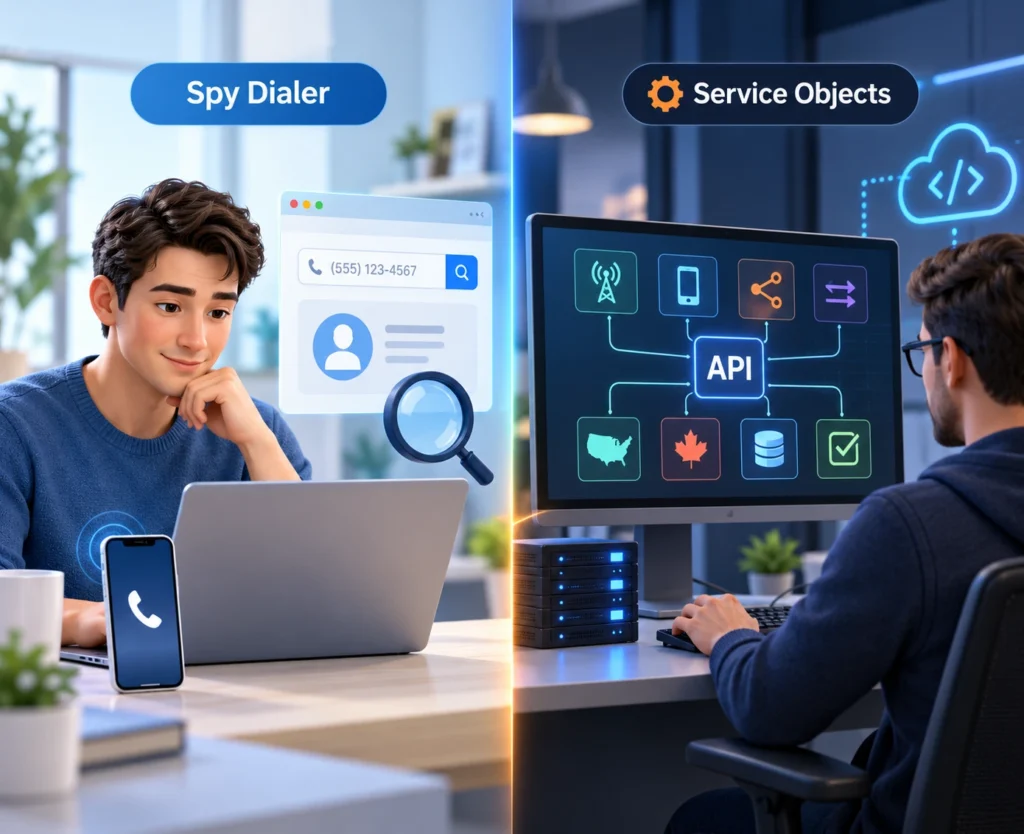
Neither option is universally better. Spy Dialer is easier for one manual search, whereas Service Objects is built for repeated validation inside business systems.
Accuracy and Data Quality
Reverse phone records are not always reliable. A number may have been reassigned, transferred to another carrier, registered under a family member, or connected to a business account. VoIP and prepaid numbers often have less dependable identity information.
Caller ID spoofing creates another problem. A scammer can make a call appear to come from a legitimate local number. Even if a lookup displays a familiar business, it cannot prove that the call actually originated there.
Service Objects provides more fields for evaluating a result, including porting dates, provider details, status indicators, and note codes. However, its GeoPhone Plus documentation explains that disconnected or unlisted numbers may return exchange information without contact details. Its Canadian coverage may also be less comprehensive than its US data.
Ease of Use and Pricing
Reverse phone lookup SpyDialer requires almost no setup. Enter the number, submit the search, and examine the result. This makes it suitable for people who only need to investigate a few calls.
Service Objects requires an API key and technical integration. Developers must format requests, process JSON or XML responses, handle errors, and protect production credentials. The added work becomes worthwhile when hundreds or thousands of records must be checked automatically.
Spy Dialer describes its current service as advertising-supported and free, with no credit card required. Service Objects offers 500 complimentary trial transactions, but its main GeoPhone Plus page does not publish a standard fixed price. Commercial costs depend on the selected service, capabilities, and transaction volume.
Best Uses for Each Option
Spy Dialer works well for:
- Checking an unfamiliar missed call
- Investigating a suspicious text
- Reviewing basic carrier or location details
- Looking for community spam reports
A business may prefer Service Objects when it needs to:
- Validate numbers during registration or checkout
- Clean outdated CRM records
- Identify disconnected numbers
- Classify mobile, landline, and VoIP contacts
- Process phone data in bulk
- Apply consistent validation rules automatically
A small company checking two numbers each month may not need a commercial API. A call center processing thousands of records would quickly outgrow a manual lookup website.
Privacy and Safe Use
Reverse lookup data should never be used to stalk, threaten, harass, or expose someone. Spy Dialer’s terms also prohibit automated data extraction and searches involving certain protected purposes.
Spy Dialer is not a consumer reporting agency. Its results cannot be used to determine eligibility for employment, housing, credit, insurance, or other decisions regulated by the Fair Credit Reporting Act.
Businesses using Service Objects remain responsible for privacy, consent, data retention, and telephone-marketing requirements. An API can support data-quality and compliance work, but it does not make an outreach campaign lawful automatically.
Never share passwords, verification codes, banking details, or identification numbers based only on a lookup result. Contact banks, government offices, and other sensitive organizations through numbers published on their official websites.
Common Lookup Problems
If no name appears, the number may be new, prepaid, unlisted, disconnected, or missing from available records. Check that it was entered correctly before trying another source.
An incorrect name may belong to a former subscriber or the account holder. Similarly, a returned city may show the carrier exchange or registration area rather than the caller’s present location.
Service Objects users experiencing API errors should check the endpoint, number format, license key, selected test type, and returned error object.
Frequently Asked Questions
Is Spy Dialer completely free?
Spy Dialer currently allows up to 50 free daily searches without an account or payment card. Limits may change.
Can both services identify VoIP numbers?
Both may classify VoIP numbers, but Service Objects provides more structured fields for automated business decisions.
Can a reverse lookup confirm a caller’s identity?
No. Records can be outdated, and caller ID can be spoofed. Verify sensitive calls independently.
Does Service Objects work outside the United States?
GeoPhone Plus covers US and Canadian numbers. Service Objects offers a separate international validation API for broader coverage.
Choosing the Right Phone Lookup
For an occasional US number search, reverse phone lookup SpyDialer is the simpler choice. It is free, quick, and requires no technical setup. Service Objects is better suited to companies that need automated validation, detailed phone intelligence, and scalable processing. In either case, treat lookup data as supporting information and verify important identities through an independent source.